Friday, June 28, 2013
The Lawn Enthusiast Takes on Pinterest
I hope everyone is enjoying their summer! I recently discovered Pinterest. There is a world of lawn/ garden tips and awesome photos people have shared from their gardens on there. I created my account this morning, so add me and let's keep spreading great lawn & garden info!

Thursday, June 13, 2013
A Crash Course in Seeding versus Sodding
To Seed or To Sod?
 |
| Image credit: gardentrek |
Warmer weather is finally upon us! So what does that mean? It means if you're looking to plant a new lawn, now is your chance! Especially if you're down in the south with the warm season grasses - which grow far better when the climate is hot. But how should you decide whether to seed your new lawn or sod it? Both methods work well, but there are
differences that should be considered in choosing the right approach for
your needs.
 |
| Image credit: foodiesathome |
When choosing whether to sod or seed, one consideration is how long you're willing to wait. Seed can
take up to two weeks to begin growing, so you will have to deal with the dirt
look for a little while. Sod, on the other hand,
is essentially an instant lawn - just lay it and you'll have a field of green.
Price is also a major consideration - and here the seed is our clear winner. Grass seed is by
far the cheapest of the two options.
Grass seed can be sown on your own, or you can opt for a professional
seeding. Either choice is cheaper than
purchasing sod and the professional installation that is recommended with it.
Grass seed is also a great choice if you have shady areas in
your yards. There is a greater selection
of grass types available when seeding a lawn, so you can purchase seed that
will grow well in shady areas, as well as full sun. Sod generally requires lots of sun to grow
properly, so you may have issues with shady areas.
The type of terrain in your yard also makes a big difference when
choosing sod or seed. If you have areas
that erode easily, or are prone to becoming run-off areas, sod is often the
better choice. It does not wash away as
seeds are prone to, and stays put after you lay it.
Grass seed and sod both require the similar care, so
at the end of the day, it's really just a personal decision depending on you and your lawn's needs. Either choice has the potential
to ultimately provide you with that lush, green lawn that you've been dreaming of. Which new lawn method is your favorite? Let us know in the comments.
-- Philip
Monday, June 10, 2013
3 Summer Lawn Diseases To Avoid
I absolutely love summer. It's my favorite time of year. I've always been a cold-natured person as well, so the warm summer weather is just perfect for me. But with the good must come the bad. Many lawn diseases are seasonal and tend to be more frequent during the warmer summer months. I decided to focus on three in particular in my most recent guest post over on the Total Landscape Care website. Read my post on 3 Summer Lawn Diseases to Avoid to learn more about them and what you can do to fight them off.


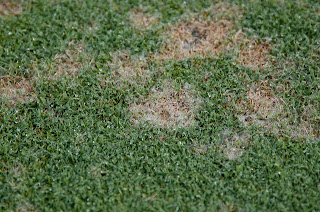
Here are the three lawn diseases. Can you name them all? Give it a shot and then take a look here to see if you were right.

Photo credit: University of Minnesota Extension

Photo credit: Cornell University

Photo credit: John Kaminski
Tuesday, May 7, 2013
Best Practices for Watering the Lawn
Fellow lawn enthusiasts! What would you say are the best practices for watering the lawn? I share some of my own advice on how to do it with both conservation and efficiency in mind over at My Green Australia, a terrific blog devoted to green and sustainable living. I hope you'll take a look. Here's my introduction...
 Watering your lawn or garden can be time consuming and expensive, especially in very dry years. So how can you get the most out of the water you use to water your lawn?
There are several ways to both conserve water and maximize the good that watering your lawn, garden, or landscaping can do. Some of them may cost a bit of money, but others are free. No matter what your budget, here are some tips almost anyone can utilize for watering their lawn....
(The rest over at MyGreenAustralia - thanks for reading!)
-- Philip
Wednesday, May 1, 2013
Choosing the Right Lawn Mower for You: A Beginner's Guide
What Kind of Lawn Mower Do I Need?

Spring is finally
here, and if you are a homeowner or if landscaping is not covered in your
rental agreement, it’s about that time to get a lawn mower so you can keep your
yard looking great. You’ll find that there are many different options available
for lawn mowers, but also a number of factors to consider so that you obtain
the perfect mower for your particular needs.
If you have a large, sprawling lawn, you may want to
consider a riding lawn mower (like that shown above). If you have
a large yard, but have several flowerbeds, decorations, swing sets, or other
obstacles, you need to make sure you have the maneuvering room that most riding
mowers require. Another important issue
to consider with riding mowers is whether there are any steep hills in your
yard. Due to their size, there is a
danger of the mower tipping over if the grade is too steep.
Also keep in mind differences in terminology. A riding lawn mower and a tractor are two
different machines. Mowers are smaller,
with the deck for the blades in the front.
Tractors typically have decks in the middle, and most have the ability
to pull other tools. These are often
used on farms and for tilling, whereas a lawn mower is the better choice for an
average yard due to its maneuverability.
 If you have a small
yard, around half an acre or less, a push mower (example to the right) may be your best choice. These
are “walk behind” mowers that are either self-propelled or moved by physically
pushing it. If you have a relatively
flat lawn, the self-propelled version can help you get the work done without
the struggle, and many have adjustable speeds for your comfort. Or you can get the classic reel mower of the
past. These have no engine, are better
for the environment, and they often cut the grass closer to the ground.
Once you have determined what size mower you need, you then
need to decide whether you want an electric or gasoline powered engine. Electric mowers are quiet, but require a
battery or cord. If you have a large
lawn, an electric mower may not be feasible.
Lawn mowers truly are a necessity, and if you take the time
to assess your needs you will have no problem choosing the right mower for you
so you can keep your lawn looking great all season.
-- Philip
Photo credits: http://www.flickr.com/photos/jjay69/5331098217/
http://www.flickr.com/photos/meaduva/1178786504/
Friday, April 26, 2013
Guest Post: An Anti-Greenwashing Dictionary for Consumers
Hello all. Philip here. I'm happy to feature another green blogger today by the name of Cameron Bruns. It's my pleasure to share her post clarifying the meanings of a variety of different "green" terminology frequently used in both the media and the marketplace. She hopes to clear up some of the confusion surrounding these terms so we can make smarter decisions as consumers. Thanks for your thoughts, Cameron! And to our readers, please be sure to take a look at her Boston Green Blog for all kinds of great ideas about green living and sustainability.

 source: http://beautybotanica.files.wordpress.com
An Anti-Greenwashing Dictionary for Consumers

Consumers
want to buy products that are good for the environment, which is great, except
that some companies are using marketing tactics to exploit this demand. People
are often rushed when they shop, so they make a quick comparisons of products
and a snap decision on what is best for their budget, their family, and the
environment. Marketers know this and design big green labels that say “All
Natural” in huge font. Even if an item is packaged in green with a leafy logo, doesn't necessarily mean it is the best option for the environment. That is why
it is important to be aware of the true definition of different “environmental” terms that may
either be used to scam you into purchasing a not-so-green product or to help
you identify the truly green options. Below are some of the most common words
used in green marketing.
All Natural - There is no industry-wide definition of “all
natural” which means companies may use the term differently. The FDA prohibits
using misleading language on labels which should prevent companies from
misusing the words “all natural”, however, the FDA does not provide specific
regulations on the term so its use is still rather hazy.
Biodegradable - A
product made of natural materials that will eventually decompose back into the
earth with the help of microorganisms.
Compostable - A material that breaks down to become dirt
that contains no toxins and can support plant life.
Eco-Friendly - interchangeable with the term “green”.
Referring to something environmentally preferable. On its own, this term
provides no specific criteria.
Fair Trade - a certification code that verifies that farmers
receive a fair price for their
products. Through Fair Trade programs, farmers receive
credit and are given necessary assistance in order to eventually become a
self-sufficient business.
GMOs - Genetically Modified Organisms, Organisms from
bacteria, plants or animals which have been genetically changed in a laboratory
through DNA technology.
Green - Vague descriptive term referring to anything
environmentally friendly.
Organic - Grown without conventional pesticides, artificial
fertilizers or sewage and processed without food additives. Food products from
animals have not been subjected to routine antibiotics or growth hormones. A
USDA Organic certified label means that the product’s claims of being organic
were verified by a third party.
Post Consumer Recycled - A product or material that was sold
or used by consumers and then reused or made into another consumer product.
Recycled - Can mean either post consumer recycled o
pre-consumer recycled. A pre-consumer recycled item is a product or material which has been recycled
or reused before it has become a consumer product. For example, an item made
from factory scraps or waste materials that have not yet been used or sold to
the general population.
______________________
Cameron Bruns is the founder of Boston Green Blog and a contributor to Merida, the premier source for distinctively
designed natural rugs with a conscience for
sustainability.
Monday, April 22, 2013
Ever thought about growing a lawn on your roof?
A living roof, or green roof, as they are also called, is a roof covered in vegetation that provides several benefits for the building it sits on and the environment of the surrounding area. Living roofs can be made up of planted vegetation or container gardens, though there are some who say plants kept in containers don't really count as a living roof. They are being utilized in several cities to provide beneficial green space where there is none and they are also used for constructing more ecologically friendly homes...
Look at the rest of my post here at the Boston Green Blog! Fascinating stuff.
Look at the rest of my post here at the Boston Green Blog! Fascinating stuff.
 |
| Image at Wikimedia Commons |
-- Philip
Subscribe to:
Posts (Atom)